Split rent, utilities and household costs with roommates
Quick answer: Split rent by recording each household expense separately, choosing who shares it and subtracting what each person paid upfront. Rent can be equal or based on an agreed room allocation; utilities start with the actual bill. For roommates, define the period clearly so this month’s expenses stay separate from outstanding payments carried over from last month.
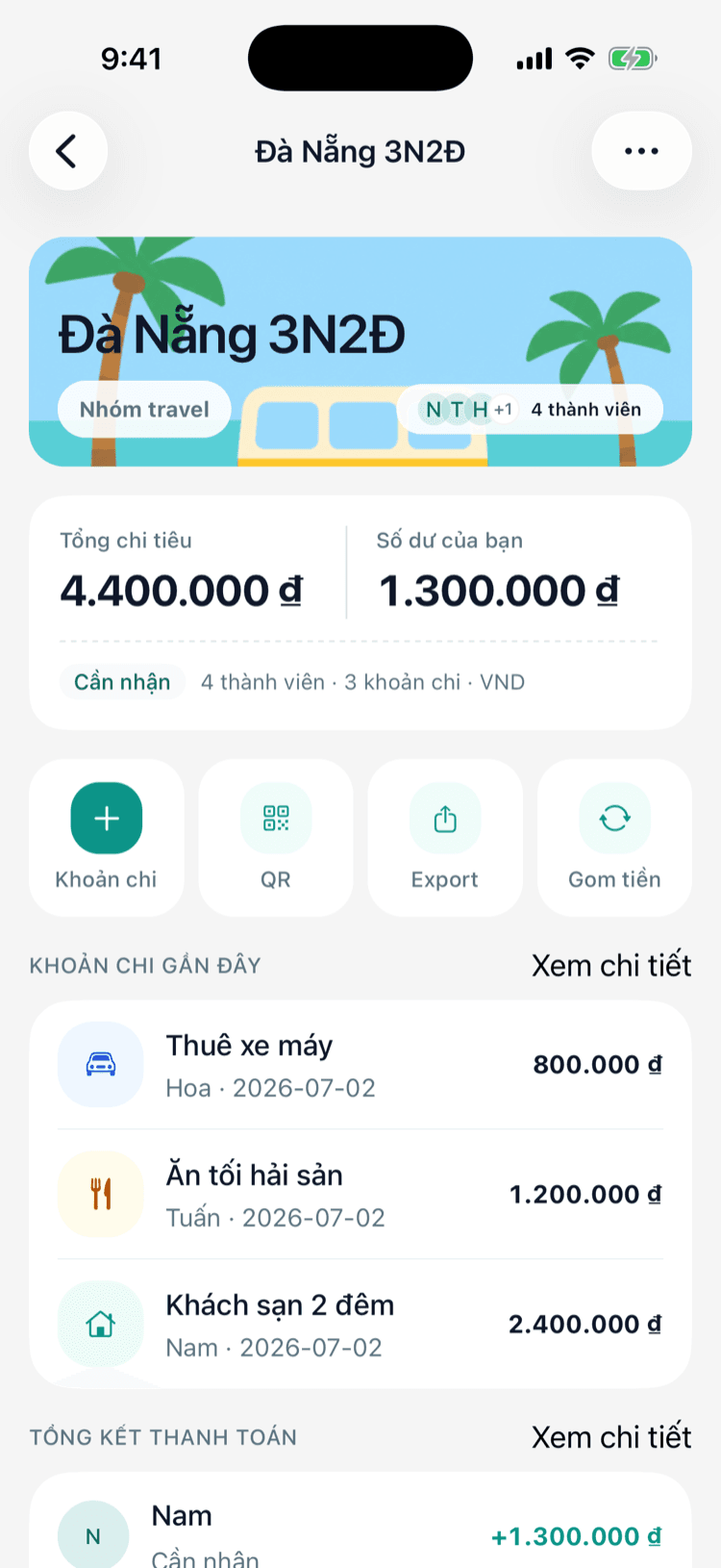
Split rent equally or agree an amount per room
An equal split works when living arrangements are comparable and everyone agrees. Different room sizes or amenities may call for agreed exact amounts before payment is due. For example, three roommates could divide VND 6,000,000 of rent as VND 2,500,000 for An, VND 2,000,000 for Bình and VND 1,500,000 for Chi.
The shares must still total VND 6,000,000. This is an illustrative agreement, not a rental price recommendation. Track a refundable deposit separately, including who contributed, return conditions and deductions; do not automatically treat money that may be returned like rent already spent.
Utilities and a roommate arriving mid-month
Use actual billed amounts rather than replacing paid costs with an estimate. Where separate meters exist, reconcile measured usage; otherwise agree on an allocation and acknowledge its limits. For a hypothetical VND 500,000 shared bill, An stays 30 days, Bình 30 days and Chi 15 days: 75 person-days altogether.
Under an agreed person-day allocation, An and Bình each owe VND 200,000 and Chi owes VND 100,000. This method does not measure each person’s electricity use and does not replace the rental agreement. Fixed charges may need a different allocation from usage-based items, so decide per expense.
Shared supplies and a complete monthly example
Separate drinking water, cleaning supplies and internet from personal purchases. In another example, three full-month roommates split all costs equally: An pays VND 6,000,000 rent, Bình pays VND 600,000 utilities and Chi pays VND 300,000 shared supplies. Total spending is VND 6,900,000 and each share is VND 2,300,000.
An should receive VND 3,700,000, settled by Bình paying An VND 1,700,000 and Chi paying An VND 2,000,000. For repeating bills, check the actual amount every month before entering it. Copying the previous amount without checking can hide a changed bill or an item nobody used this month.
Monthly checklist and moving-out reconciliation
Define the start and end of the period, check receipts and payers, confirm shares, then reconcile reimbursements before circulating the result. Keep last month’s unpaid balance distinct from new expenses to avoid charging it twice. When someone leaves, list bills still pending, shared items retained and deposits awaiting return so everyone can agree on handling them.
The web calculator suits calculating and exporting a period’s result; browser storage is not a long-term backup. In the app, expense and payment history supports reconciliation across periods. Keep an agreed copy of the closing figures when a roommate joins or leaves.
Supporting references
The Consumer Financial Protection Bureau (CFPB) bill calendar helps track monthly due dates. The Splitwise rent calculator offers a reference for factors such as room size and amenities. Roommates still need to agree on the final allocation rather than treating a suggested calculation as an obligation.
Frequently asked questions
- Must rent and utilities use the same split?
- No. Each expense can have its own participants and allocation. Rent can follow an agreed room arrangement while utilities use actual bills and a separate agreed method. Check that shares for each expense match its total before adding everything into monthly balances, especially if one person only joined partway through.
- Does a half-month stay always mean paying half?
- There is no single proportion suitable for every expense. Fixed rent follows the agreement; utilities might use days stayed if everyone accepts that method. Work out exact shares per bill and record the reasoning instead of halving every cost. A person-day calculation is an allocation choice, not proof of actual consumption.
- How do we avoid charging someone twice after a transfer?
- Distinguish payments to a supplier from reimbursements between roommates. An expense creates each person’s share; a reimbursement reduces what is still owed. At month-end, check both records and request the remainder. Do not record a transfer reimbursing a roommate as another household expense or the total will be overstated.
Related guides
Try your monthly rent and utility split
Open the roommate example, replace the names and actual bills, then choose equal shares or exact amounts matching your agreement. Export the result so everyone can check the monthly figures together.