Collect group payments through one agreed person
Quick answer: Collect group payments in Chitipay by routing settlement through one agreed person: those who owe pay the collector, who passes money to those owed. Each person’s expense share stays unchanged. This suits a group that has already recorded spending and wants one contact to track both incoming payments and reimbursements going out.
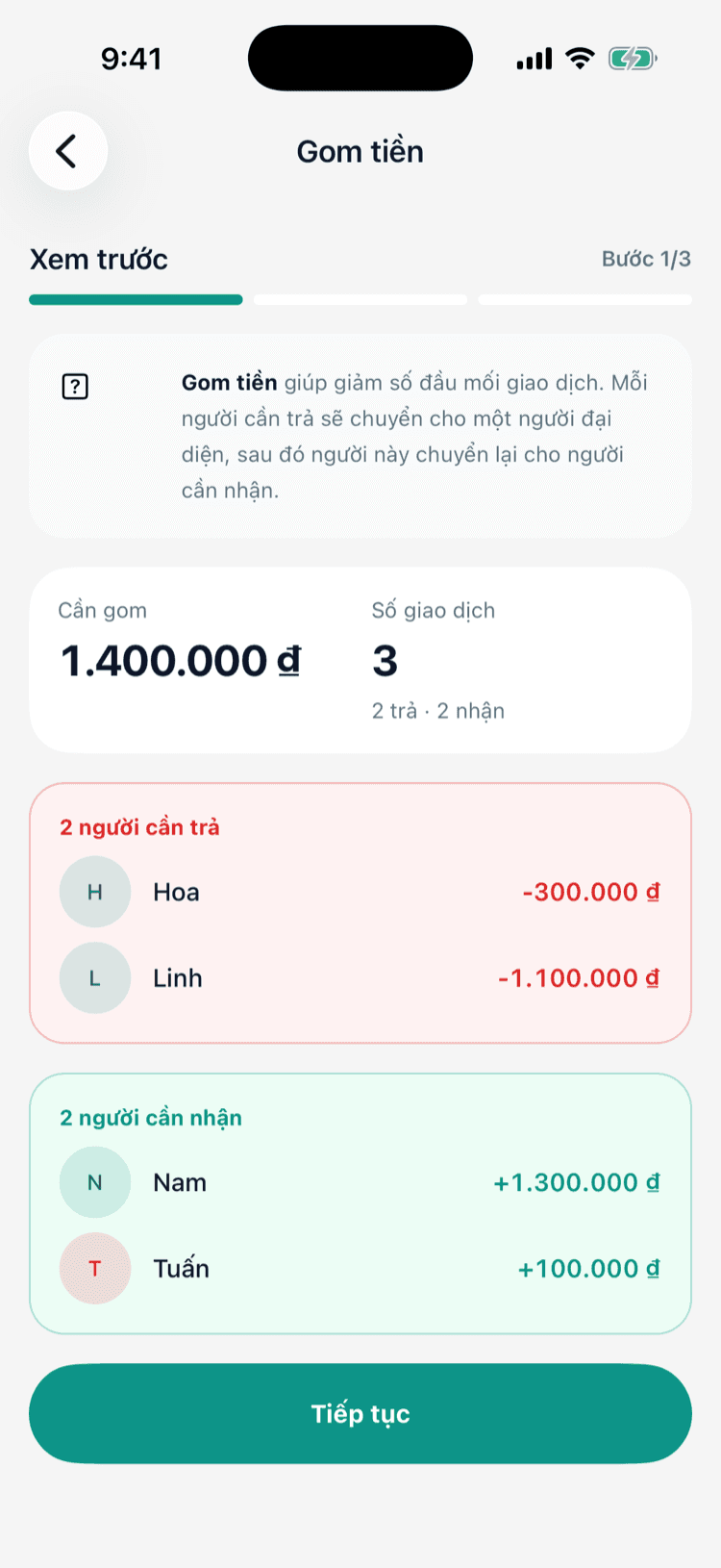
Collect group payments or settle directly?
Both methods start from the same expense list and balances. Direct settlement connects people who owe with people who should receive money; collection routes transfers through the chosen representative. The collector still owes their own expense share and is not automatically exempt from contributing.
This is not a separate fund with an arbitrary contribution target: record actual expenses and allocations before calculating settlement. Choose a collector when everyone agrees that person can handle both incoming and outgoing payments. The decision changes the payment route, not who ultimately bears the cost or who should be reimbursed.
Example: a collector who did not pay upfront
Suppose An, Bình, Chi and Dung share a hypothetical VND 1,200,000 expense paid by An. Each share is VND 300,000, so An should receive VND 900,000 back. With Bình as collector, Chi and Dung each send Bình VND 300,000. Bình adds their own VND 300,000 and sends An VND 900,000.
Bình receives VND 600,000 but pays out VND 900,000 because they still owe their own share. Do not split that outgoing transfer again: it reimburses an existing expense. Direct settlement also takes three transfers in this example, showing why collection should not be assumed to reduce the count.
Checklist for paid amounts and outstanding balances
First reconcile expenses and participants and agree on the collector. When money arrives, check the bank account history against sender, amount and transfer note. In the app, record the actual payment to track what remains; generating a suggested transfer does not mean it happened. If someone pays only part, record only the amount received.
Before paying a recipient, check both collected funds and the collector’s own contribution. Money temporarily held for others is not the collector’s personal reimbursement. Keep incoming and outgoing records separate enough to explain why cash held can differ from the collector’s own balance.
Web calculations and payment QR codes in the app
The web calculator lets you try expenses, select a collector and view the suggested transfers; export the result for reconciliation. Group payment tracking and VietQR belong to the app flow. VietQR supports recipient details, amount and transfer note when suitable bank information is provided; the payer still authorizes the transfer in a banking app.
Chitipay does not move money automatically or infer receipt just because a QR code was opened. If the group adds or edits an expense, review remaining amounts alongside recorded payments before requesting more. Use the bank’s actual transaction record when confirming receipt, not the existence of a payment request.
Supporting references
Splitwise explains simplifying debts without changing total balances; this distinguishes amounts owed from payment routes, rather than documenting Chitipay’s collector mode. The National Payment Corporation of Vietnam (NAPAS) VietQR guide covers scanning, checking the recipient and confirming a payment through a banking app.
Frequently asked questions
- Does collection always mean fewer transfers?
- No. The count depends on how many people owe, how many should receive money and who collects. Its benefit is an agreed contact for tracking. Compare direct and collector suggestions and choose a route the group understands. In the four-person example above, either route requires three transfers to settle.
- Can the collector keep everything they receive?
- No. Incoming money can include amounts owed to people who paid expenses upfront. The collector keeps only what their own balance entitles them to receive. Reconcile inflows, outflows and their own contribution, as in the example where Bình receives VND 600,000 but must send An VND 900,000.
- Can we use this to collect a fund before spending?
- This page covers settlement of recorded expenses, not a fund-management tool for advance contributions. If money has been collected but not spent, track contributions, money held and refund conditions separately. Do not create an invented expense solely to generate a collection request, because that would misstate what the group actually spent.
Related guides
Collect group payments for expenses already recorded
Open the free example, replace its expenses and participants, then choose a collector to see the payment route. Check both incoming and outgoing amounts before the group makes any transfers.